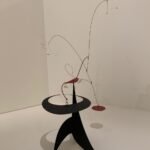

Calder: Where Science Meets Imagination
Whether or not you work in the art world, the exhibition of Alexander Calder is always worth seeing! It offers a rare blend of authenticity, curiosity, and the meeting point of science and art.
Writing about Alexander Calder in just a few hundred words feels almost impossible. No short text can fully capture his imagination. Even the exhibition at the Fondation Louis Vuitton in Paris can only reveal part of his creative universe.
The show celebrates the 100th anniversary of Calder’s arrival in Paris in the 1920s. It was the era of Art Deco, Piet Mondrian and Vasily Kandinsky—artists who deeply influenced the young American.
A Child’s Curiosity That Never Disappeared
In France, people simply call him Calder.
He was more than an artist. He embodied the curiosity and freedom of childhood—qualities that many people lose as they grow older.
Throughout his life, Calder kept exploring the ideas that fascinated him as a child. Balance, movement, and gravity became the centre of his work. Although he trained as an engineer, his engineering mindset had appeared long before university.
First came the circus. Later came the mobiles, a name given to his moving sculptures by Marcel Duchamp.
The Circus and the Mobiles
Calder’s circus featured handmade figures of people and animals. He created entire performances, from horse jumps to magic acts.
A film from 1961 shows these miniature scenes in motion. Their simple construction and expressive movement remain captivating today.
Science, Nature, and Colour
Nature inspired Calder throughout his career. He carefully observed movement, balance, and natural forms. His creative process relied on experimentation, physics, and constant trial and error.
Colour played an equally important role. Even the smallest sculptures combine bold shapes with carefully chosen colours. His mobiles create changing relationships between form, light, and colour, inviting viewers into imaginary worlds.
Simplicity with Endless Depth
Calder’s world is pure yet full of contradictions: from the clean shapes of his mobiles to the aesthetically simple, almost clumsy circus figures.
The exhibition offers glimpses into both worlds and his inspirations, making it hard to choose a preferred reality—true, authentic, and funny or beautiful, ephemeral, and imaginary…
We also invite you to explore the artists collaborating with Lunartis Studio!